
Here's something that worries me.
I try to help journalism students to acquire the skills they need to get jobs.
That's what the Multimedia Journalism project is all about.
But what worries me is that the number of jobs in what you might call traditional journalism is shrinking fast.
Pretty much every day there are reports of cutbacks and lay-offs by the traditional employers of journalists: publishers and broadcasters.
It's not that journalism skills aren't still in demand. Infact, many more people in a range of disciplines other than traditional journalism now need those skills.
That's because of the growth of social and other online media, and their use by marketers, public relations professionals, communicators and brand managers.
And because, as a result of the accessibility of social and online media, every company is a media company.
What is emerging is a new form of journalism - brand journalism. It requires all the traditional journalistic skills to do it well, but it also requires an understanding of marketing and PR.
Journalists have often seen PR as a dark art, and one that they would only move across to if their career in 'pure' journalism hit a brick wall.
They can't afford to think like that any more. And there is no need to see well-practised brand journalism as any lesser craft than the journalism required by publishers and broadcasters.
So I'm working on a new project.
Its working title is Brand Journalism: A Practical Guide to a New Medium.
It will be for those in all the disciplines mentioned above.
It will give journalism students and journalists the essential additional knowledge, understanding and practical skills they need in marketing, public relations, and communications.
And it will teach marketers, public relations and communications professionals, and brand managers what they need to learn about journalism.
It will take the form of a textbook - in both paper and ebook format - plus a comprehensive supporting website. And, as you'd expect, it'll also exploit the full range of social and mobile media.
As things develop, and the project takes shape, I'll post updates here. Meanwhile, and as a first step, I've begun to curate the topic of Brand Journalism on Scoop.it. You can find it here.
Thursday, 8 December 2011


Friday, 25 November 2011
Instagram: it's Twitter for photojournalists... previewing Masterclass 40 at MMJ
Follow @andybull

You follow people, hopefully they follow you, and you – and they – can comment on each others photos, and click to like them.
We looked at Instagram as one of the six smartphone apps featured here that I think are among the best on the market for journalism
The app itself is purely mobile based, so you can’t use it on a static computer.
However, like any successful social platform, apps are being created that stretch its usability
Let’s take a look at four of them, in no particular order. They’re new, and still under development, but they are worth checking out:
I can view as a grid or as a blog-style list
To get started you go here and enter your Instagram account name
It brings up your recently posted Instagram images. Here are mine:

You get your own url at Instagrid. Here’s mine: http://instagrid.me/andybull
The app expands the reach of Instagrid, the purely iPhone-centric app, by allowing you to invite people who don't use Instagram to subscribe to your feed via email.
I can also subscribe to the photographers whose work I like, and receive their new Instagram photos in an email every few days.
You can also create #hashtag galleries.
They say: “Instantly create a gallery of all the photos tagged with a specific #hashtag. It's a great way to keep track of a set of photos for yourself, your company, a conference or event.”
Now if I’d been careful to tag my recent photos from one or two of the locations I’ve shot I could create a good personal gallery. Sadly I wasn’t, but here’s what I got with the hashtag London:

One problem with this is that, if I have tagged my photos and want to use only them in my gallery, any other photos on Instagram tagged with the same hastag will be pulled in among mine. Instagrid tell me they are working on a filter so you can avoid this happening.
People can subscribe to my Instagrid channel if they wish. I can subscribe to as many uses as I like and get their images combined in a weekly newsletter
Here are some Instagram follows Instagrid recommends:
mikeyk founder of instagram
fashion street fashion, instagram style
nettatheninja got a job @square after posting this viral website
photojojo purveyor of camera culture
laughingsquid internet man, blogger Scott Beale
hellomuller designer of substance
dcurtis also a designer of substance
erickschonfeld writer for techcruch
threadless behind the scenes at the famous tshirt company
They also have a printing service for your pix here.

Inkstagram does what Instagrid does but, in my opinion, with a better looking interface. You log in through Instagram.
Here’s a grab of my Instagram feed as presented by Instagrid:

I get my photos presented at about twice the size they appear on my phone

I can see either my feed, my own photos, photos I’ve liked, and other options by clicking on the tabs along the top of the screen.
I can also create, customise and share hashtag albums from Instagram.
Heres one #occupylondon:

You get a url, but not a neat one using your account name. Here’s mine: http://inkstagram.com/#/users/2214714
You do, however, get a nicely-designed presence on the site. Here’s mine:

Statigram is different in that it gives you stats on your pictures - which are the most popular, the most commented on, and so on, which makes it the most comprehensive of the four apps we're looking at:

The 'like' history, which gives you a graph that shows immediately which were the msot popular pictures and when they were taken, is really useful.
It also offers what it calls snapshots, well-presented graphics of various aspects of your life on Instagram that you can share with your instagram community.
Here's one that gives my three most popular pix:

I email those to myself from the app, then upload them into my Instagram feed. I can even put the filter of my choice on them.
They say: “It's easy. Simply fill in your username or hashtag and configure the styling options on the right.
“Then click PREVIEW to see what the widget will look like and GET CODE to get the snippet that you need to paste into your website.
You can preview what your gallery will look like:

And get the code to paste your gallery into your website:

Here’s what the embedded gallery looks like:
40D
Instagram is a great iPhone social platform for photojournalists
It's like a visual version of Twitter
Like Twitter it does one thing really well. It lets you enhance and publish your stills to a community.You follow people, hopefully they follow you, and you – and they – can comment on each others photos, and click to like them.
We looked at Instagram as one of the six smartphone apps featured here that I think are among the best on the market for journalism
The app itself is purely mobile based, so you can’t use it on a static computer.
However, like any successful social platform, apps are being created that stretch its usability
Let’s take a look at four of them, in no particular order. They’re new, and still under development, but they are worth checking out:
Instagrid
Instagrid creates an Instagram gallery on your computer that you can use to browse your photos and share them with friends outside the Instagram community.I can view as a grid or as a blog-style list
To get started you go here and enter your Instagram account name
It brings up your recently posted Instagram images. Here are mine:
You get your own url at Instagrid. Here’s mine: http://instagrid.me/andybull
The app expands the reach of Instagrid, the purely iPhone-centric app, by allowing you to invite people who don't use Instagram to subscribe to your feed via email.
I can also subscribe to the photographers whose work I like, and receive their new Instagram photos in an email every few days.
You can also create #hashtag galleries.
They say: “Instantly create a gallery of all the photos tagged with a specific #hashtag. It's a great way to keep track of a set of photos for yourself, your company, a conference or event.”
Now if I’d been careful to tag my recent photos from one or two of the locations I’ve shot I could create a good personal gallery. Sadly I wasn’t, but here’s what I got with the hashtag London:
One problem with this is that, if I have tagged my photos and want to use only them in my gallery, any other photos on Instagram tagged with the same hastag will be pulled in among mine. Instagrid tell me they are working on a filter so you can avoid this happening.
People can subscribe to my Instagrid channel if they wish. I can subscribe to as many uses as I like and get their images combined in a weekly newsletter
Here are some Instagram follows Instagrid recommends:
mikeyk founder of instagram
fashion street fashion, instagram style
nettatheninja got a job @square after posting this viral website
photojojo purveyor of camera culture
laughingsquid internet man, blogger Scott Beale
hellomuller designer of substance
dcurtis also a designer of substance
erickschonfeld writer for techcruch
threadless behind the scenes at the famous tshirt company
They also have a printing service for your pix here.
Inkstagram
Inkstagram does what Instagrid does but, in my opinion, with a better looking interface. You log in through Instagram.
Here’s a grab of my Instagram feed as presented by Instagrid:
I get my photos presented at about twice the size they appear on my phone
I can see either my feed, my own photos, photos I’ve liked, and other options by clicking on the tabs along the top of the screen.
I can also create, customise and share hashtag albums from Instagram.
Heres one #occupylondon:
You get a url, but not a neat one using your account name. Here’s mine: http://inkstagram.com/#/users/2214714
You do, however, get a nicely-designed presence on the site. Here’s mine:
Statigram
Statigram also offers you a good browser-based interface, in which you can choose to view your Instagram feed, your own phones, those you've liked, popular posts, and pix from those you follow, or who follow you.
As the name suggests, it's also keen on statistics.
You get a neat public url. Here's mine: http://statigr.am/andybull
Here's my feed:

Statigram is different in that it gives you stats on your pictures - which are the most popular, the most commented on, and so on, which makes it the most comprehensive of the four apps we're looking at:
The 'like' history, which gives you a graph that shows immediately which were the msot popular pictures and when they were taken, is really useful.
It also offers what it calls snapshots, well-presented graphics of various aspects of your life on Instagram that you can share with your instagram community.
Here's one that gives my three most popular pix:
I email those to myself from the app, then upload them into my Instagram feed. I can even put the filter of my choice on them.
Snapwidet
Snapwidget is different from the three apps we've looked at so far because it lets you embed an Instagram photo gallery for a specific username or a hashtag on your blog or website.They say: “It's easy. Simply fill in your username or hashtag and configure the styling options on the right.
“Then click PREVIEW to see what the widget will look like and GET CODE to get the snippet that you need to paste into your website.
You can preview what your gallery will look like:
And get the code to paste your gallery into your website:
Here’s what the embedded gallery looks like:
Next: Check out the rest of Masterclass 40
Friday, 11 November 2011
How to build a Google+ page for your journalism
Follow @andybull
The Google+ page feature is fresh out of the box
It’s only been possible for a few days to create a professional presence on Google+
Facebook’s Mark Zuckerberg immediately charactarised it as a Facebook-inspired mini-me.
There’s some truth in what he says.
But what we need to decide is whether Google+ pages enhance the platform for journalism.
And they most certainly do.
It’s dead easy to set up a Google+ page for your journalism. So what’s to lose?
If the platform tanks, you wasted 15 minutes. If it succeeds – and I think it has to – you are in at the start of a great new social mechanism.
So here is a step-by-step guide to creating your Google+ page.
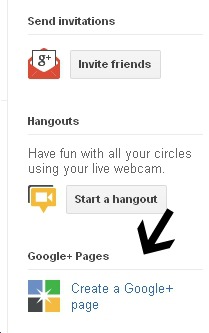
First, click the logo whcih I've arrowed on the right side of your page:
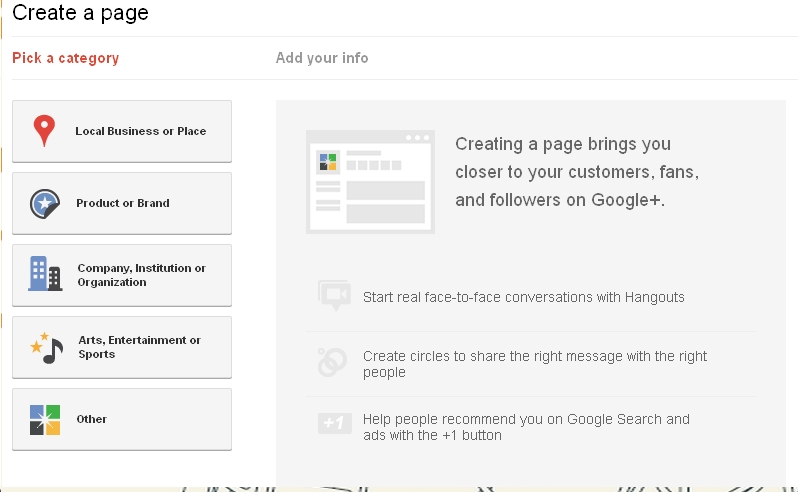
Select the category (you have to decide whether you and/or your journalism fits best under such headingss as product, brand or company:
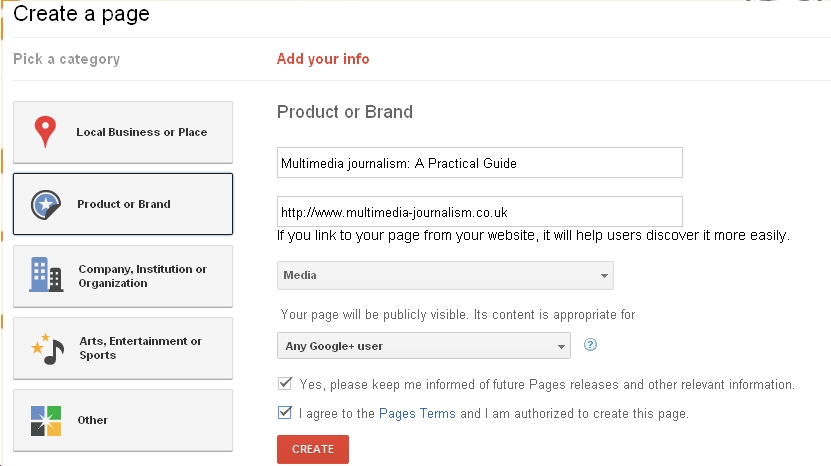
Add your info. You can link to your website at this point:
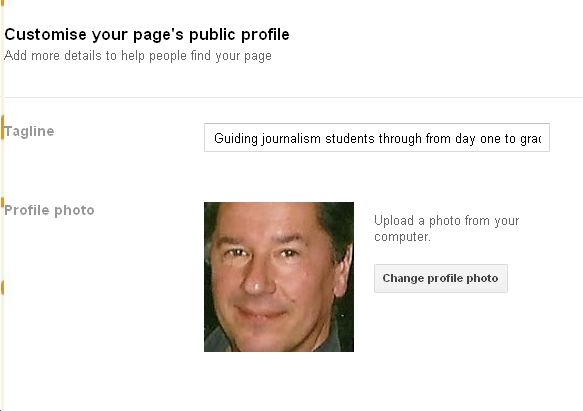
Once some whirring has taken place, you can add a tag line and a profile picture (see this module for how to customise your profile picture):
You get taken back to your page and you have this:
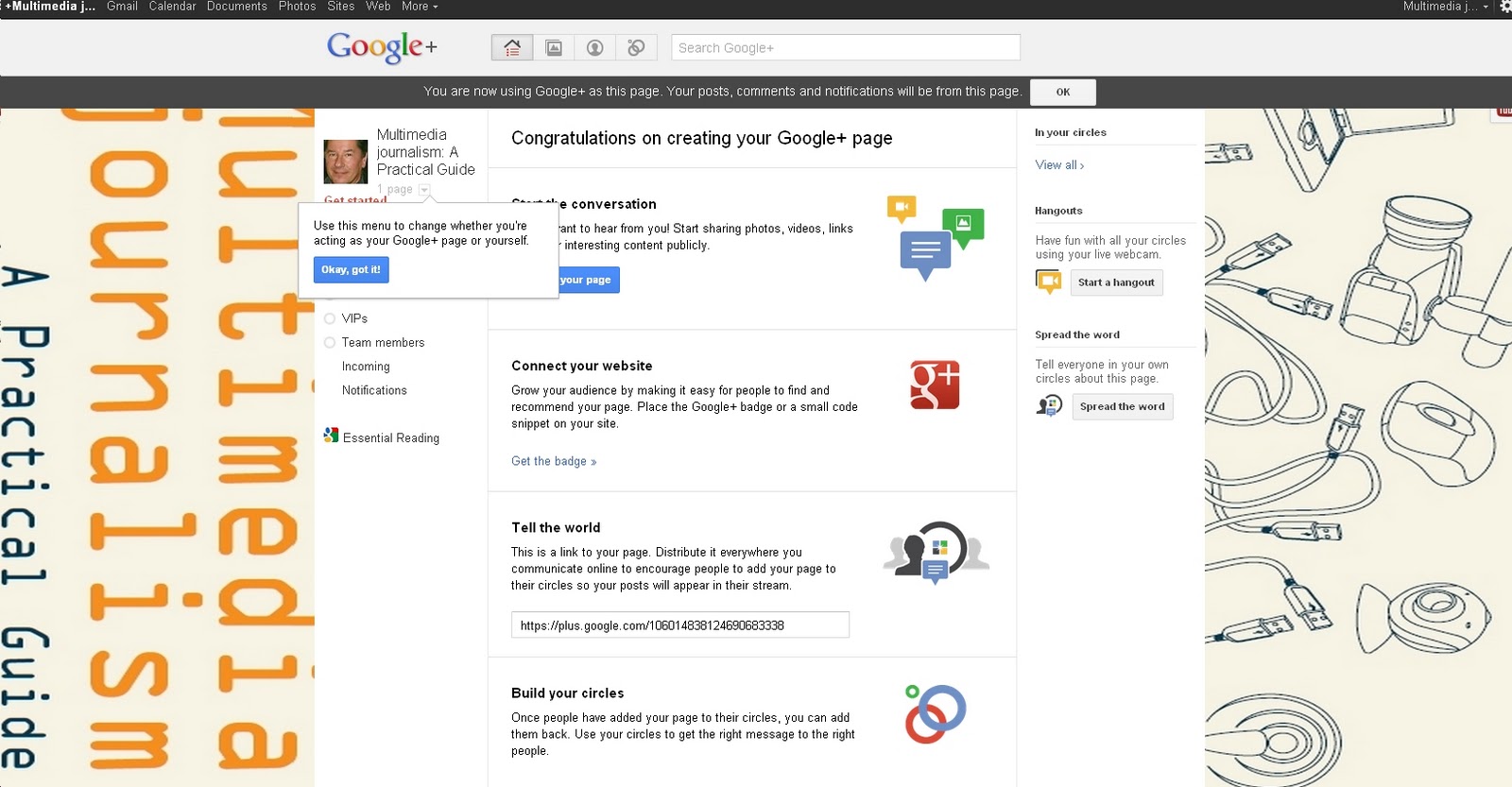
Here you can add information, promote and switch between using Google+ as yourself or as your page.
One thing to make clear: you now have two ways of using Google+ - as yourself or as your page - just as with Facebook you have your news feed and your page.
If you followed Masterclass 38 on building proficiency with Facebook, all of this will feel very familiar.
You can add a logo to your website to show you have a Google+ page:
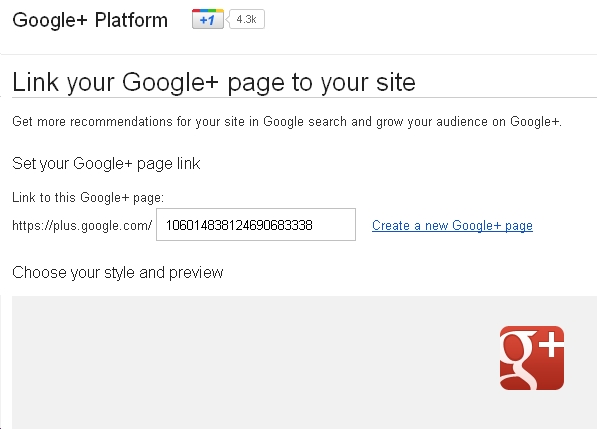
Add a post:
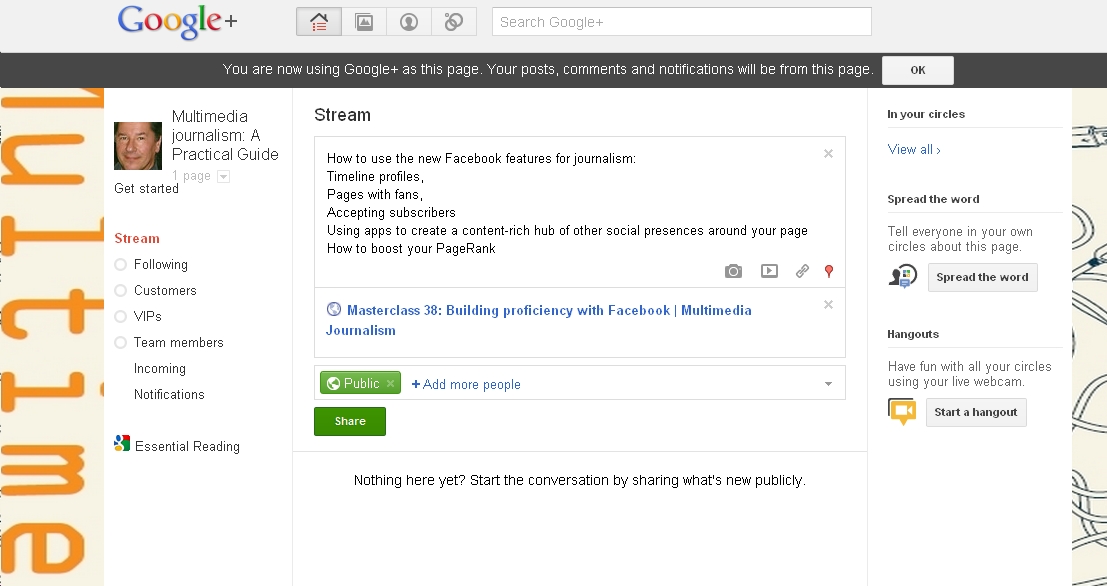
On the right is Share the word, .. where you can tell everyone in your circles about your new page.
Then you get to pimp your profile here:
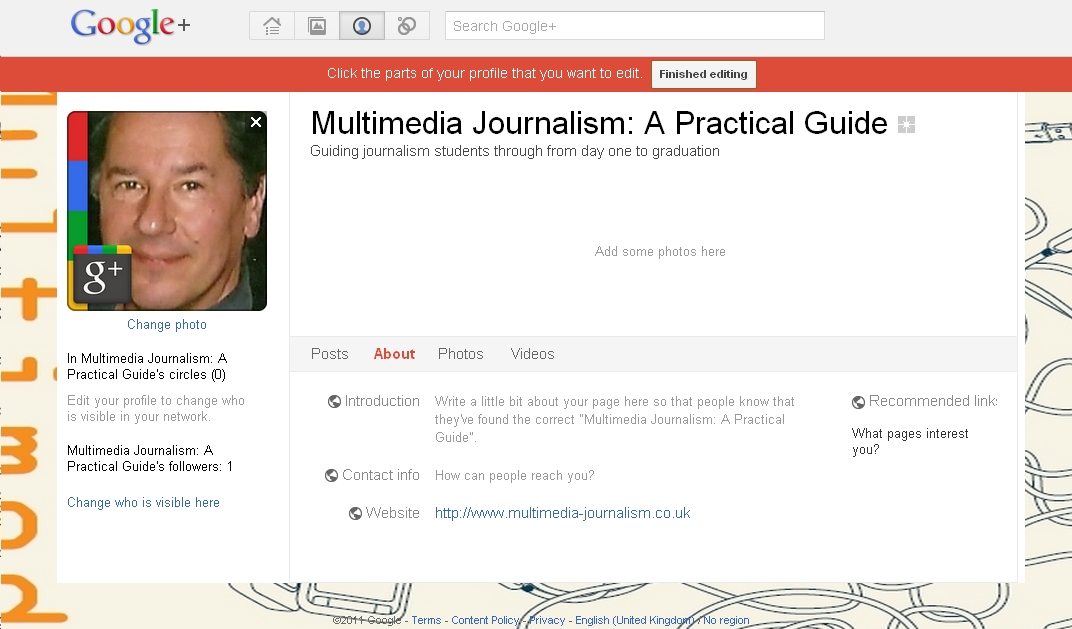
You can add text about what you do, photos and videos.
So you end up with a presence that has text about you, to which you can add photos and videos:
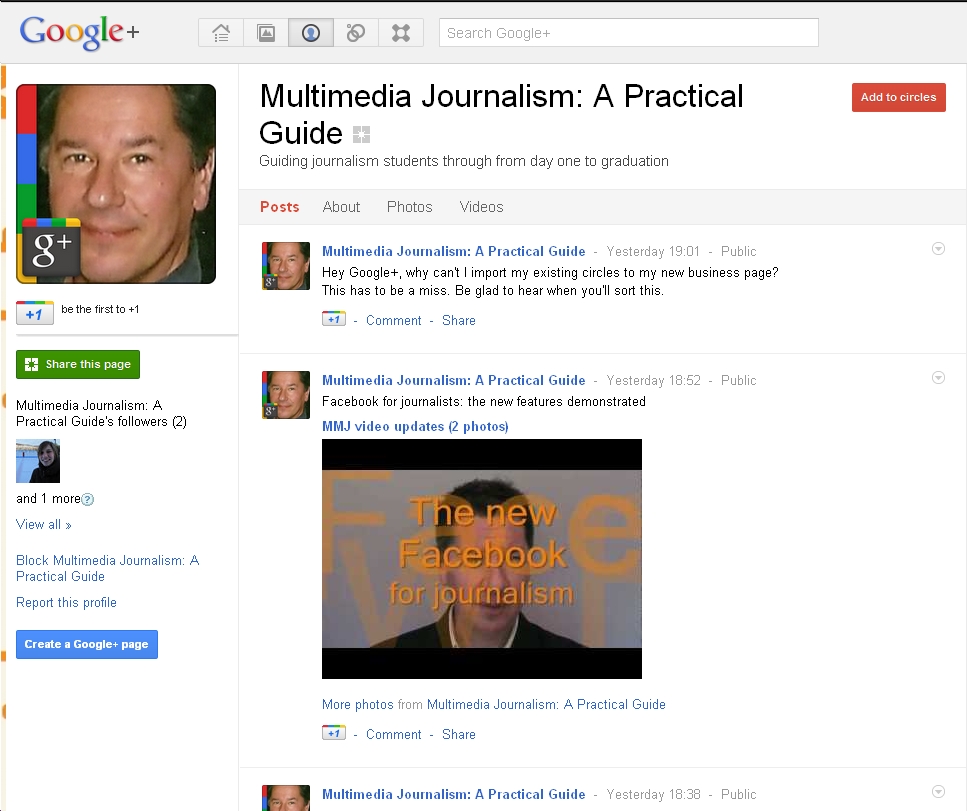
One frustration is that you don’t automatically have your existing circles added to your new page. This is such a miss that it must be sorted very soon. I’ll update here when it is.
Another is that using Google+ as yourself, and as you page, feel like entirely separate entities. Again, I'm sure sharing posts between the two will quickly be made easier, and I'll update here when it does.
39E
This post is a preview of Masterclass 39: Building proficiency with Google+
You can find the full masterclass hereThe Google+ page feature is fresh out of the box
It’s only been possible for a few days to create a professional presence on Google+
Facebook’s Mark Zuckerberg immediately charactarised it as a Facebook-inspired mini-me.
There’s some truth in what he says.
But what we need to decide is whether Google+ pages enhance the platform for journalism.
And they most certainly do.
It’s dead easy to set up a Google+ page for your journalism. So what’s to lose?
If the platform tanks, you wasted 15 minutes. If it succeeds – and I think it has to – you are in at the start of a great new social mechanism.
So here is a step-by-step guide to creating your Google+ page.
First, click the logo whcih I've arrowed on the right side of your page:
Select the category (you have to decide whether you and/or your journalism fits best under such headingss as product, brand or company:
Add your info. You can link to your website at this point:
Once some whirring has taken place, you can add a tag line and a profile picture (see this module for how to customise your profile picture):
You get taken back to your page and you have this:
Here you can add information, promote and switch between using Google+ as yourself or as your page.
One thing to make clear: you now have two ways of using Google+ - as yourself or as your page - just as with Facebook you have your news feed and your page.
If you followed Masterclass 38 on building proficiency with Facebook, all of this will feel very familiar.
You can add a logo to your website to show you have a Google+ page:
Add a post:
On the right is Share the word, .. where you can tell everyone in your circles about your new page.
Then you get to pimp your profile here:
You can add text about what you do, photos and videos.
So you end up with a presence that has text about you, to which you can add photos and videos:
One frustration is that you don’t automatically have your existing circles added to your new page. This is such a miss that it must be sorted very soon. I’ll update here when it is.
Another is that using Google+ as yourself, and as you page, feel like entirely separate entities. Again, I'm sure sharing posts between the two will quickly be made easier, and I'll update here when it does.
For more on using Google+ for journalism, go here
Friday, 4 November 2011
Is Google+ deader than the digital-Dodo, or a rival to Twitter and Facebook?
The jury’s still out on
Google+
Will it become the essential
third social platform for journalism, alongside Twitter and Facebook?
Or will it fade, as previous,
much-trumpeted Google features such as Buzz and Wave have done?
My hunch is it’s going to
end up lagging third in the rank of usefulness to journalists for at least a
year.
But I could be wrong.
It may
tank.
When I checked how many of the 724 people in my circles were inactive,
using the Uncircle+ app, almost a third hadn’t posted for
a month.
That doesn’t look good.
So why bother with it?
Well, because I can’t see
Google letting it die without a very hard fight.
Google+ is being positioned
at the heart of Google’s operations.
Google is integrating all other applications with it, in an effort to make it the essential social web-home where all is
available.
Google has plenty of other apps it can integrate with it.
Reader has now been
integrated, so that you can add any of the items you gathered in the Reader, from the RSS feeds we looked at in this Masterclass to your feed, and
share them with your circles.
YouTube, which Google also
owns, now appears as a tab to the right of your screen. Click on it and you’re asked: What do you want
to play?
Add a search term and you get a pop-up with relevant videos, plus a
box asking what you’d like to play next.
And you can share the videos
you watch with those in your Circles.
So, you can stay here for
YouTube as well as Reader.
It follows, then, that Google+
is not just a social network: it is an effort to create a backbone for
all Google services - and the full implications of that are only just becoming obvious.
As Adam Tinworth pointed out when I posted about inactive
accounts on Google+: “People forget that in the early days of Twitter people
would sign up and let their accounts go fallow for months. This is normal for
the early stages of a new social service…”
For that reason, I believe
it’s worth building our proficiency with it.
I’ll be posting a full masterclass
on enhancing your use of Google+ for journalism soon. Check here for updates.
Friday, 28 October 2011
Using the new Facebook features for journalism: timeline profile, subscribe and share
Follow @andybull

A lot's changed on Facebook.
You may have heard about Facebook Timeline, which replaces the old style profile.
If you haven’t don’t worry.
We’ll cover it.
And we’ll look at the new ways a journalist can use this new-style timeline profile in conjunction with a fan page – like the ones we built in Masterclass 34
The developments mean you now not only have a place for your journalism - your fan page - but also a more personal space for you as a journalist - your new-style timeline profile.
Because, while you can still invite fans to like your page, you can also now invite people to subscribe to your updates on your new-style timeline profile.
And you can now divide your Facebook community into distinct groups – not unlike the Circles concept on Google+ – and post different content to different groups.
If it sounds complicated, that’s because it is!
But it also gives us a lot more potential for using Facebook for journalism.
So we’ll run through all the new stuff, and demonstrate how it can be used.
38A
Ever been driving down a new road and suddenly found you’ve caught up with the construction team?
That’s the sensation I’ve been getting using Facebook in the past couple of weeks
The Facebook construction team is laying down the social media equivalent of hot tarmac as fast as they can, but public launch has been delayed, and the cars are backing up impatiently, wanting to use this new stretch of road.A lot's changed on Facebook.
You may have heard about Facebook Timeline, which replaces the old style profile.
If you haven’t don’t worry.
We’ll cover it.
And we’ll look at the new ways a journalist can use this new-style timeline profile in conjunction with a fan page – like the ones we built in Masterclass 34
The developments mean you now not only have a place for your journalism - your fan page - but also a more personal space for you as a journalist - your new-style timeline profile.
Because, while you can still invite fans to like your page, you can also now invite people to subscribe to your updates on your new-style timeline profile.
And you can now divide your Facebook community into distinct groups – not unlike the Circles concept on Google+ – and post different content to different groups.
If it sounds complicated, that’s because it is!
But it also gives us a lot more potential for using Facebook for journalism.
So we’ll run through all the new stuff, and demonstrate how it can be used.
Fortunately, none of those changes invalidate anything we covered in Masterclass 34's Getting started with Facebook section.
But, just to check you are up to speed, and ready for this masterclass on Building Proficiency with Facebook, here’s what we covered in Getting Started:- Opening a Facebook account
- Setting up a profile page for you as a journalist and a separate Facebook page for your journalism. (One quick point: profiles are now called timelines)
- Posting content to Facebook – and what works best
- Gaining friends on Facebook, and finding people to invite to view your page
- Promoting your Facebook page with a content-rich widget on your website
- Posting content on Facebook – what works best
- Finding and researching stories on Facebook
Here’s what we'll cover in the following modules:
Next: Creating a timeline as your public profile
Wednesday, 19 October 2011

Thursday, 13 October 2011
How to take your use of social media to the next level: three linked masterclasses for journalists
Follow @andybull
They follow on from our masterclasses on Getting Started in Social Media
They fit into the second level of tuition at MMJ, the one called Building Proficiency
As such they sit alongside the other subjects that you'll find at the Building Proficiency level in the textbook and on this companion website.
This tuition is currently available exclusively on the website, but will be adapted for inclusion in future editions of the MMJ print and ebook.
After a few days free-to-air it will be available only to registered users of MMJ. The benefits of registration are outlined here. To register, you need to buy the textbook, in ether paper or ebook form.
If you are registered with MMJ you can use these resources to gain a full, up-to-date guide to using social media for reporting:
A further programme at the Professional Standards level is in the schedule. Check here for news of it.
37-9

We're going to be running a series of MMJ masterclasses for journalists on building proficiency in social media over the next few weeks
They follow on from our masterclasses on Getting Started in Social Media
Here's a quick preview of our programme of learning:
These linked masterclasses form the second of three co-ordinated learning programmes and are part of a comprehensive guide to the use of social media for journalismThey fit into the second level of tuition at MMJ, the one called Building Proficiency
As such they sit alongside the other subjects that you'll find at the Building Proficiency level in the textbook and on this companion website.
This tuition is currently available exclusively on the website, but will be adapted for inclusion in future editions of the MMJ print and ebook.
After a few days free-to-air it will be available only to registered users of MMJ. The benefits of registration are outlined here. To register, you need to buy the textbook, in ether paper or ebook form.
Here are our learning goals: To develop and enhance the professional presences you have established for yourself, and/or the titles you work on, with the following social platforms:
- Facebook 9including all the recent developments on that platform)
- Google+
- You Tube
- Foursquare
- Digg
- Delicious
- Friendfeed
To demonstrate how to optimise your use of Twitter, Facebook, Google+ and YouTube in regard to:
- The design and branding of your presence on each platform
- Promoting these social media presences on your websites and blogs
- Using a range of tools to optimise your effectiveness on them
- Managing your social media accounts efficiently using a range of tools
To further develop your ability to use social media for story finding and research, and in identifying contacts and experts, through the use of more advanced social media search tools.
Social media for reporting
A number of recent masterclasses have looked at how to use social media as reporting tools
Because of that, we aren't covering that topic here.If you are registered with MMJ you can use these resources to gain a full, up-to-date guide to using social media for reporting:
Exercises and projects
The final units in each of these three, linked mastercalsses hold a series of exercises, designed to enable students to research the use of social media; and projects, designed to enable groups of students - or individuals - to hone their skills as social media journalists.Further learning programmes
There is a Getting Started learning programme hereA further programme at the Professional Standards level is in the schedule. Check here for news of it.
LIVE from October 14: Masterclass 37: Building proficiency with Twitter
Subscribe to:
Posts (Atom)


